

Evidence-led builder's guide
Lumibricks Review: Are These Integrated LED Building-Block Sets Worth Buying?
Compelling illuminated scenes, with a more involved build. The evidence, costs and trade-offs for adult collectors.
1. Introduction: What Is Lumibricks?
Lumibricks sells display-oriented building-block sets that make lighting part of the product experience rather than an optional afterthought. Illuminated shops, cabins and futuristic streets offer adult builders a different reason to collect: the finished scene changes character after dark.
Wires and power requirements add work that an unlit model avoids. For collectors and gift buyers, the evidence supports a qualified recommendation—not easier construction or flawless quality.
2. Lumibricks at a Glance
Evidence labels separate company statements, reviewer findings and assessment.
| Item | Snapshot | Evidence basis |
|---|---|---|
| Product category | Brick-built illuminated display sets | Lumibricks |
| Primary audience | Adult collectors; ages vary by set | Company / assessment |
| Core differentiator | Lighting planned into construction | Hands-on reviewers |
| Themes and models | Shops, streets, cabins, fantasy, vehicles | Official catalogue |
| Lighting approach | LEDs, wiring and model-specific power options | Company / reviewers |
| Brick compatibility | LEGO-style system format; no LEGO affiliation | Company statement |
| Price range | Sampled bestsellers $34.99–$149.99; larger sets exceed this | Official USD prices, October 15 |
| Instructions | Printed manuals and searchable PDF downloads | Official library / reviewers |
| Warranty and parts | Stated 24-month limited warranty; replacement requests | Company policy, October 15 |
| Shipping | US, Canada, Germany, UK and China warehouses | Company policy, October 15 |
| Best for | Atmospheric shelf and desk scenes | Editorial assessment |
| Potential drawbacks | Careful wiring, QC exceptions, repair complexity | Reviewers / assessment |
3. Product Range, Themes, and Design Identity
Themes span Town Life, Street Fusion, Cyberpunk Neoncity, The Old West, Retro House, Steampunk World, Farm Life, Middle Ages, Vacation, Road Trip and Vehicle. The current storefront also lists Blade Runner 2049; the range is not exclusively unlicensed.
Shop interiors and illuminated signs give the varied subjects a coherent display identity. Originality and modularity are company claims, not independently proven catalogue-wide. The Toy Book confirmed the Funwhole-to-Lumibricks rebrand in June 2025; Funwhole is not a separate competitor.
Newsstand: a smaller starting point
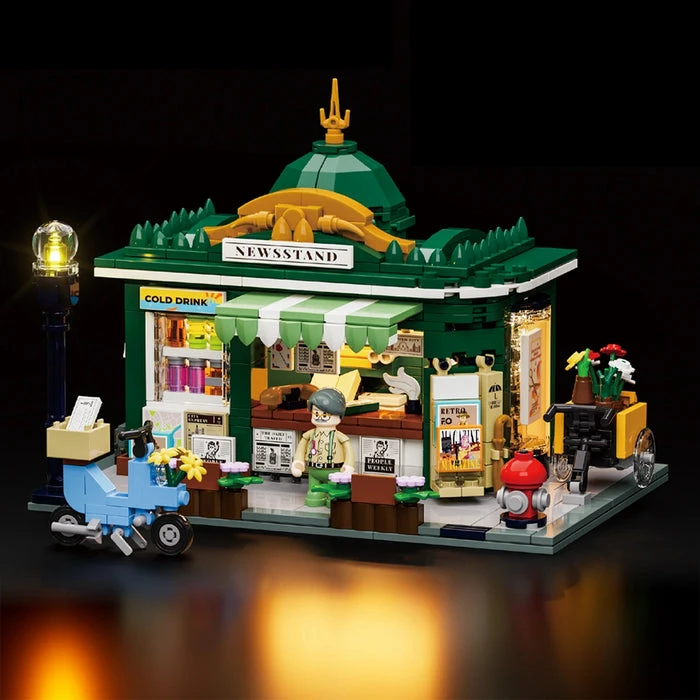
Available US variant: $34.99 on October 15. Current company specifications list 595 pieces, age 8+, three warm LEDs and printed decoration. Older image labels say 556 pieces; confirm the version. This is the smaller starting point for first-time adult builders.
Izakaya: a substantial neon display
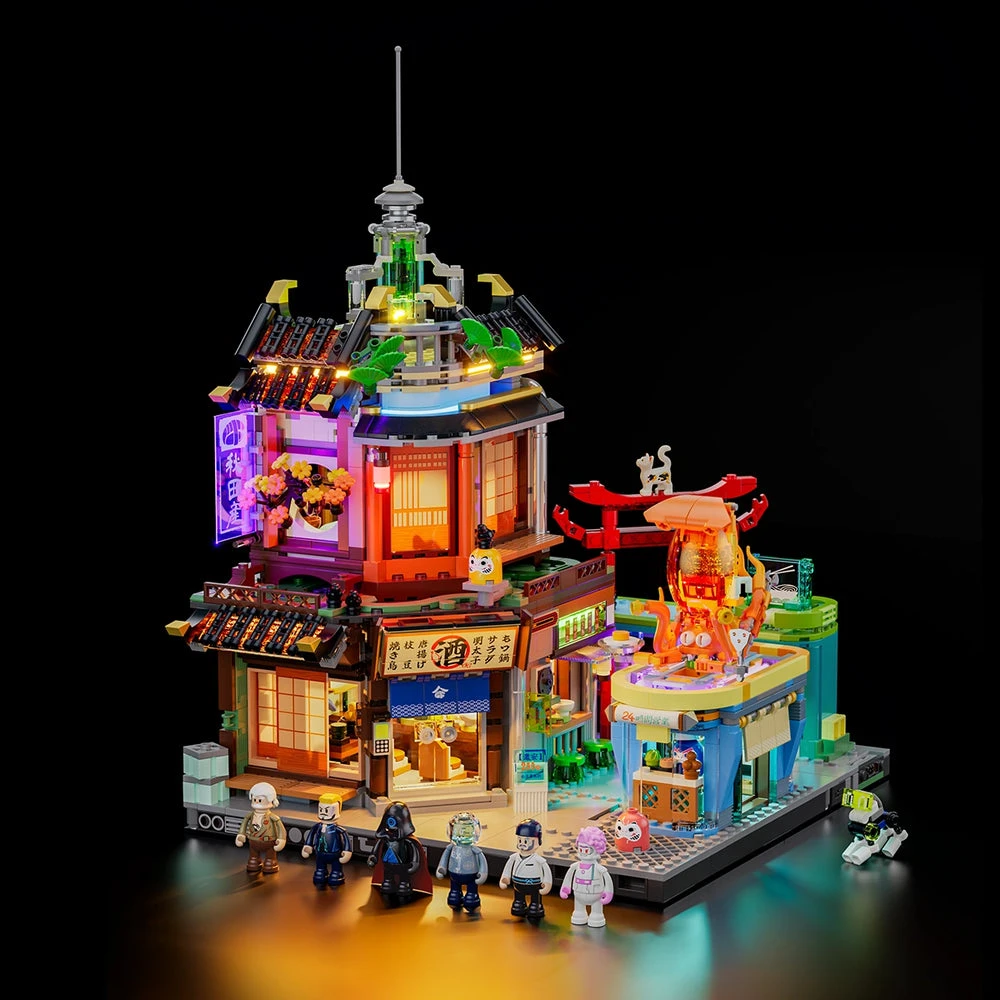
Available US variant: $129.99, with 1,987 pieces, age 16+ and 20 LEDs according to Lumibricks. Cool and yellow lighting surrounds a layered food-street scene with removable access. It suits patient cyberpunk collectors, not quick gift builds.
4. The Central Question: How Good Is the Integrated Lighting?
Planned integration, not effortless installation
The Right Brick reports purpose-made routing elements and cable paths through walls and floors. Merlins Bricks' Barbershop review documents electronics checks before installation. These support the integration claim: lights are incorporated during construction rather than necessarily threaded through a finished model afterward.
A dramatic display does not make construction easier. Thin wires require care; pinched cables can interrupt assembly. Routing parts reduce clutter, but repairs and rebuilding require reopening sections. Customization should preserve connection access.
Power, effects and troubleshooting
Newsstand lists coin-cell and USB/power-bank operation; Izakaya lists battery-holder, USB and Type-C options. A reviewed Barbershop included a USB-C hub and a box needing three separately supplied AA batteries. Confirm package contents: controllers, expansion boards and floor contacts are model-specific. Brick compatibility does not establish electrical compatibility.
Lumibricks' FAQ specifies maximum 5V power, discourages prolonged USB-charger use and warns about heat or damage from higher or unstable voltage. Follow the manual; never connect USB directly to mains. Published testing claims were not independently audited; no electrical or heat testing was performed here.
Reviewers praise atmosphere and lit signs, not measured brightness or battery runtime. Daylight photographs should also guide the purchase. For failures, the FAQ describes isolating branches on the expansion board; replacements and email assistance exist, but long-term connector availability remains uncertain.
5. Brick Quality, Build Experience, Instructions, and Display Value
The Right Brick reports firm clutch across its stated 15-plus builds. Merlins Bricks found attractive colours in Barbershop, but greater susceptibility to micro-scratches and less-sharp UV printing close up. These are reviewer impressions, not tolerance measurements or a guarantee for every batch. Transparent-element optical quality is insufficiently documented.
Reviewers praise numbered bags, separate electronics packaging and staged lighting instructions. Similar dark colours can be hard to distinguish. The official searchable PDF library includes revised versions and multipart books.
Exceptions matter. Its-Not-Lego's supplied Barbershop had a missing printed tile and duplicated manual pages; corrected digital instructions reportedly arrived that evening. Merlins Bricks also found parts needed pressing together after opening the modular model. Neither establishes a brand-wide defect rate.
Company build estimates are two hours for Newsstand and twelve for Izakaya—not observed times here. Shelf-display appeal is well supported; moving opening models demands care. Premium-looking does not mean uniformly rugged.
6. Price, Value, Availability, Shipping, and After-Sales Support
Value includes lighting, printed parts, design, packaging and support—not just piece count. The bestseller band is not the entire catalogue. An unlit model may be better value if lights go unused. Best Buy lists Izakaya, but an independently confirmed US transaction price was unavailable; no direct-store saving is claimed.
The October 15 policy estimates 1–3 business days processing plus 3–5 business days US-warehouse transit, or 6–12 from China. Inventory varies; China multi-set orders may arrive separately. Taxes, import charges and physical-address restrictions affect checkout.
The stated 24-month warranty covers manufacturing defects, missing parts and shipping damage, excluding wear, misuse, modifications and later accidents. Claims need order details, photos, explanation and manual SKU/page. The promised two-business-day response is not a replacement-delivery deadline.
Non-EU returns require unused original-condition goods within 30 days, with customer-paid non-quality shipping. EU withdrawal provisions differ. Do not assume built sets qualify. Buyer feedback includes helpful service and frustrations; promises are not measured service performance.
7. Comparison With Competitors
LEGO: the mainstream premium benchmark
LEGO is the mainstream benchmark for an established brick ecosystem, licensed franchises, instructions and retail access. Its US site provides missing- and broken-piece requests, digital instructions and a store locator. Editorially, it is the stronger shortlist for existing LEGO collectors, though no resale appreciation is established. Lumibricks has no LEGO affiliation.
Himeji Castle 21060 was $159.99, 2,125 pieces and age 18+, with the main US listing marked sold out on October 15. It is an unlit landmark, not an equivalent neon streetscape. Brickset's supplied-sample review praised construction and detail but found mismatched dark-tan slopes: premium does not mean flawless. No controlled brick-fit comparison is available.
CaDA: a genuinely relevant factory-lit alternative
CaDA's Japanese Bookstore C66020W was available at $89.99 USD, with 1,292 pieces, age 14+ and included LEDs. It overlaps meaningfully with Lumibricks' architectural-display proposition rather than competing only through technical vehicles. Its more conventional Japanese storefront may suit someone who likes illuminated shops but not dense cyberpunk scenery. Lumibricks offers a broader mix of fantasy and neon environments within the sampled catalogue.
Printed bricks and warm lighting are CaDA specifications, not proof of superior molding or easier instructions. Its wider range includes automotive licences; the brand is not wholly unlicensed. The store provides replacement-part requests and estimates 5–15 business days international transit after dispatch. Returns require sealed, unused goods; verify warranty and delivered cost independently.
Light My Bricks: upgrade the model already owned
Light My Bricks is an aftermarket electronics supplier, not a complete brick-set alternative. Its current Himeji Castle kit was available at $99.99 USD. The model is sold separately; it offers digital “Light As You Build” and “Light After Build” instructions, so aftermarket does not always mean installation only after construction. Its two-year warranty and faulty-component request process are published commitments, not comparative service-performance evidence.
Castle plus kit totals $259.98 before power, shipping and tax—not an available bundle while LEGO is sold out. The kit specifies matched 5V/2.4A power and careful connector alignment. It suits existing LEGO owners seeking night-time impact, but adds a purchase, installation and separate support relationship.
Across all three choices, system-brick customization must be separated from proprietary electrical connections. No measured brightness ranking or universal build-difficulty winner is justified. Lumibricks is most persuasive when the desired original-style scene and included lighting fit the buyer's taste; LEGO, CaDA or an add-on kit can win for ecosystem, a particular subject or an existing collection—not simply a lower piece price.
| Brand/category | Strongest use case | Lighting proposition | Main strengths | Main compromises | Best for |
|---|---|---|---|---|---|
| Lumibricks | Atmospheric original-style scenery | Factory-included; build-integrated | Planned routing, varied settings, PDFs | Delicate wiring; model-specific QC | Lit-display collectors |
| LEGO | Landmark and licensed collecting | Himeji Castle unlit | Ecosystem, retail/support infrastructure | Lighting extra; selected set sold out | Existing LEGO collectors |
| CaDA | Japanese storefront display | Bookstore includes LEDs | Relevant architecture; printed-parts claim | International delivery; verify terms | Conventional lit-shop builders |
| Light My Bricks | Illuminate an existing LEGO set | Separate model-specific kit | Two installation methods; published support | Model and power cost extra | Existing-model owners |
8. Pros and Cons
Pros
- Lighting is planned into the reviewed builds.
- Distinctive neon, shop and cabin display subjects.
- Smaller and substantial build options.
- Numbered packaging praised by reviewers.
- Searchable, revised digital manuals available.
- Published warranty and lighting-parts request process.
Cons
- Thin wiring demands careful installation.
- Power supplies and batteries need checking.
- Similar instruction colours can be confusing.
- Documented manual and missing-part exceptions.
- Opening modular builds can disturb connections.
- Limited independent long-term reliability evidence.
9. Who Should Buy Lumibricks—and Who Should Skip It?
Collectors wanting lit desks, gaming rooms or shelves are the strongest fit. Gift buyers should confirm the recipient welcomes electronics in the build.
Beginners should start smaller, such as Newsstand, or choose unlit models if wiring sounds frustrating. Compare alternatives for specific franchises, local access or LEGO collecting. Selected Lumibricks models support batteries; portability is not universal.
10. Final Verdict
Lumibricks is worth buying for patient adult display builders who specifically want an illuminated scene, not for buyers expecting lighting to simplify assembly. Its strongest apparent advantage is coordinated architectural storytelling and lighting in one purchase. Delicate wiring, variable model stability and occasional QC failures are meaningful compromises.
Buy for the scene and accept careful wiring. Skip for easy rebuilding, minimal troubleshooting or a specific franchise. No numerical score is assigned without comparative testing.
11. FAQ
Is Lumibricks compatible with LEGO-style bricks?
The company states system-brick compatibility. That does not establish electrical compatibility, identical tolerances or official LEGO affiliation.
Are lights included, and how are they powered?
The selected sets include LEDs. USB and battery arrangements vary; check included accessories and follow the model’s power instructions.
Are the sets suitable for children?
Age ratings vary: Newsstand lists 8+, Izakaya 16+. Small parts and delicate electronics warrant age-appropriate supervision; this is not an independent safety endorsement.
Is Lumibricks good value compared with LEGO or CaDA?
It can be for lighting-first displays. Compare the complete model, included electronics and delivered cost—not piece counts alone.
What happens if parts or lights are defective?
Use the replacement form or support email with order details, SKU, manual page and photos. Eligibility follows the stated limited warranty.
Are the sets easy for beginners?
Smaller models are a better starting point. Reviewers praise staged instructions, but wires and colour differentiation add difficulty.
Sources and methodology
Research completed October 15, 2026; no direct product or laboratory testing. Official catalogue, About, FAQ, policies, support and PDF-library pages supplied company statements. Specialist hands-on reports supplied qualified observations; some used free samples or affiliate links. Buyer feedback is self-reported, not a verified defect-rate study. Prices and selected US stock were checked on that date.
Official sources
- Lumibricks catalogue and About · About
- Newsstand · Izakaya
- FAQ · Compatibility statement · PDF manuals · Customer-review page
- Shipping · Returns · Warranty · Replacement parts
Independent and comparison sources
- Merlins Bricks: Barbershop, March 20, 2026
- Its-Not-Lego: Barbershop, March 14, 2026
- Trustpilot: self-reported buyer feedback
- LEGO Himeji Castle · LEGO replacement parts · Brickset hands-on review, July 28, 2023
- CaDA Japanese Bookstore · CaDA FAQ and parts system · CaDA returns
- Best Buy Izakaya listing
- Light My Bricks Himeji Castle kit
Information, prices, policies, and availability may change; verify details with the seller before purchase.